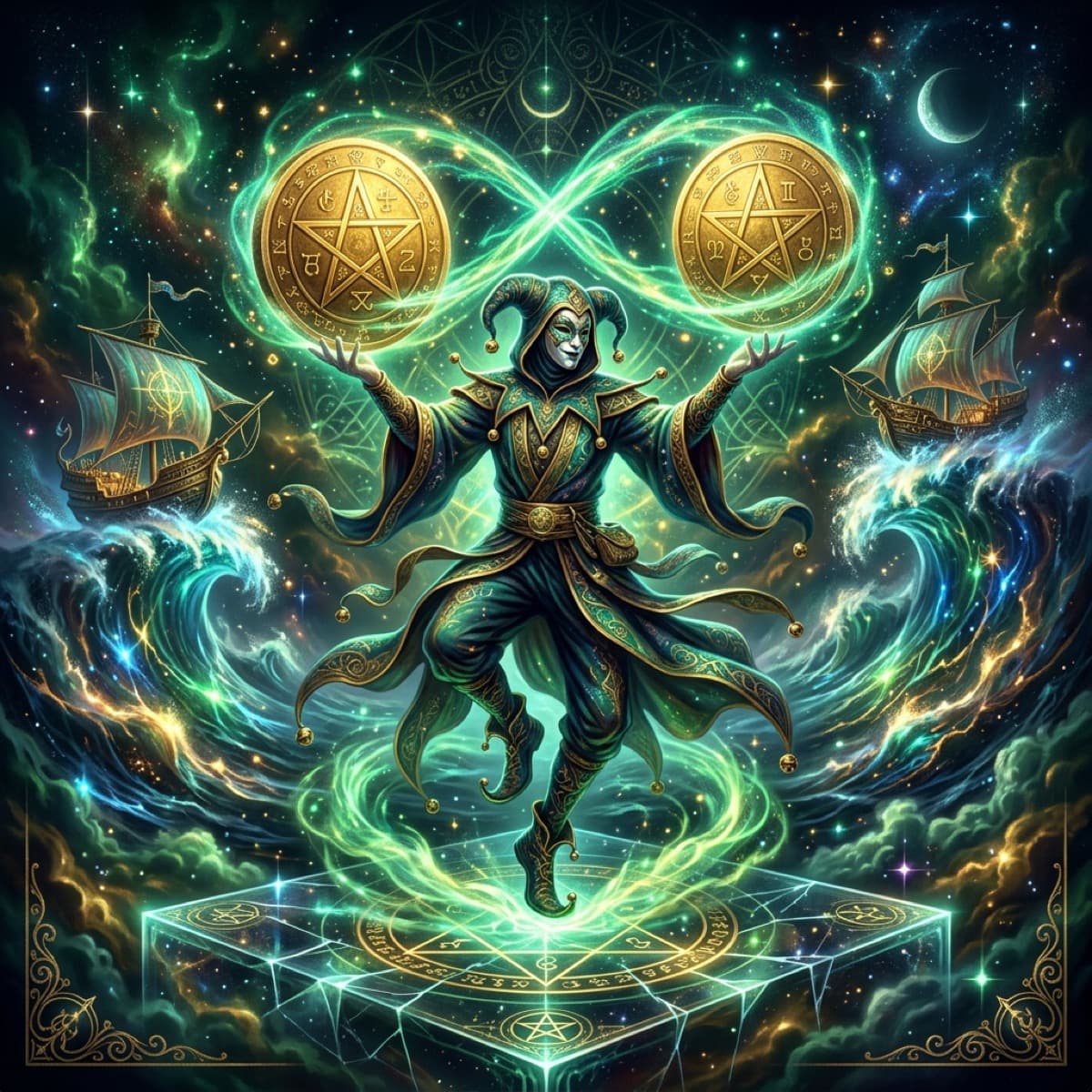
Key Insight
This article reframes tarot as a cognitive toolkit for engineers, stripping away mysticism to reveal a structured system for pattern recognition and scenario modeling. It explains the 78-card deck as a bounded library of human experience archetypes, where a reading functions as an algorithm: the query sets the initial state, the shuffle introduces controlled entropy, and the card spread acts as a dynamic state diagram mapping relationships. The utility is presented in engineering terms: as a Monte Carlo simulation for life narratives, a tool for root cause analysis via reversed cards, and a method to stress-test perspectives and explore variables that pure logic often ignores, thereby bypassing cognitive bias.
Want your personalized reading?
Experience our AI divination system combining ancient wisdom with modern insights.
Executive Summary: Tarot isn't mysticism; it's a structured system for pattern recognition and scenario modeling. For engineers, it functions as a cognitive tool to bypass bias, map decision trees, and explore subjective variables that pure logic ignores. This guide reframes the Major Arcana as system archetypes and the spread as a dynamic state diagram.
Reframing the System: Tarot as a Cognitive Toolkit
In my decade of guiding analytical minds, I've found engineers reject tarot not because it's irrational, but because its presentation is. Let's strip away the esoteric packaging. A tarot deck is a bounded set of 78 unique data points (cards), each representing a fundamental human experience, challenge, or archetype—a "library of human conditions." The reading is a function: you input your query (initial state), the shuffle introduces controlled entropy (random variable), and the spread layout acts as the algorithm defining the relationship between data points.
Think of it as a Monte Carlo simulation for your life's narrative. You're not predicting the future; you're stress-testing perspectives. A recent client, a systems architect, used a simple three-card spread to model outcomes for a career move. The cards didn't "tell" him to go; they highlighted the emotional cost (Five of Cups), the required foundational work (Ace of Pentacles), and the potential innovative breakthrough (The Star) his purely pro/con list had missed.
| Engineering Concept | Tarot Analog | Utility |
|---|---|---|
| State Diagram | Card Spread (e.g., Celtic Cross) | Maps the relationships & transitions between states (past, present, future, internal/external influences). |
| Root Cause Analysis | Reversed Cards & Card Positions | Identifies blockages (reversed energy) and contextualizes factors (position meaning). |
| Scenario Modeling | Drawing Multiple Outcome Cards | Explores potential futures based on current trajectory and choices. |
The Protocol: A Skeptic's First Reading
Try It Now — Free Reading
✦ 100% Free · Private · Instant Results
Approach this as a debug session for your psyche. Your goal isn't belief; it's data collection.
- Define the Query: Frame it as a problem statement. "Debug my persistent anxiety about project X." Not "What does my future hold?"
A mechanical engineer once told me, "The Three of Swords didn't predict heartbreak. It modeled the logical consequence of poor communication in my team—the 'heart' of the project was failing."
Ready to explore this for yourself? Try a free tarot reading now and see what the universe reveals about your situation.
Engineer's FAQ: Addressing Core Objections
Isn't this just the Forer Effect (Barnum Statements)?
It can be, if you use generic interpretations. The power lies in specificity. A card like The Hermit means nothing alone. In the "Advice" position of a spread about a failing startup, it becomes a direct command: "Isolate the core technical innovation." This mirrors the clarity sought in a reading for freelancers in a client drought—actionable isolation, not vague platitudes.
How is this different from a pros/cons list?
A pros/cons list operates on known, conscious variables. Tarot, through its random draw, introduces the *unknown unknowns*—the subconscious fears, hidden opportunities, or emotional variables your rational mind sidelines. It's the difference between a linear equation and a system with emergent properties.
Can I model this in a spreadsheet?
Absolutely. Mapping card meanings to decision weights is a valid exercise. In fact, creating a system to simulate tarot readings with a free spreadsheet can deepen your understanding of the deck's combinatorial logic, proving its utility as a framework, not magic.
Try It Now — Free Reading
✦ 100% Free · Private · Instant Results